
Morgan County Projected Release Dates
A projected date is a forward-looking calculation. ODRC defines its “Expected Release Date/Parole Eligibility Date” as a projected release date or a date pending parole consideration. Ohio records may also show an earliest possible transfer date, POA date, PRD, sentence expiration, supervision expiration, or next parole-hearing date. Each label answers a different question. Parole eligibility means consideration can occur. It is not a release grant. Supervision expiration concerns the end of control after physical release.
An actual release date records an event that has occurred. For state prison, ODRC's Released status and release or parole detail are stronger after the event than an older estimate. For a local Morgan County booking at Southeastern Ohio Regional Jail, the statutory jail register records the date and manner of discharge. The related court docket explains the legal authority, such as bond, time served, dismissal, a sentence, or transfer.
A pretrial detainee generally has no sentence-based projected date. Bond, recognizance, another hold, dismissal, or a new court order can determine when custody changes. A person sent from SEORJ to ODRC has left the local jail but remains incarcerated. Calling that transfer a release creates the wrong record trail.
Run a Morgan County Release Lookup
Start with the last known custody system and the sentencing court. Morgan County uses a regional jail, so local detainees are held at SEORJ in Nelsonville. ODRC can place a state prisoner in any institution in its system. The commitment county identifies the sentencing county, while the prison assignment and later residential county may be elsewhere.
- Collect the full name, date of birth when lawfully known, case number, booking ID, or ODRC offender number.
- Read the Morgan County court docket to identify pretrial status, sentence, jail-time credit, judicial release, or a prison commitment.
- If ODRC has custody, search statewide by offender number or name and open the matching detail.
- Record the exact date label, sentence entries, current status, and date of the lookup.
- If SEORJ has custody, ask the court and jail about the applicable order, credits, holds, and release record.
- After the projected day, verify an actual release or transfer through ODRC, SEORJ, or the destination agency.
For felony matters, use Morgan Common Pleas CourtView. County Court covers relevant misdemeanor and traffic cases. A docket may establish a sentence or authority for judicial release, while the jail record shows physical departure. If several case numbers are tied to the booking, check each one because one resolved charge may not clear another hold.
The broader Morgan County released-inmate search explains how court, jail, state, and federal records connect. For a date lookup, keep the inquiry narrow: which date, under which sentence, in which custody system?
ODRC Morgan County Release Fields
The ODRC Offender Search is the primary date channel for a Morgan-sentenced state prisoner. Its form accepts last and first name, offender number, county of commitment, residential county or ZIP for supervision records, status, and next parole-hearing month. Try a statewide name or number search if the Morgan filter misses a record, because an offender can have more than one commitment county.
| ODRC field or status | Meaning for release timing |
|---|---|
| Expected Release Date/Parole Eligibility Date | A projected release date or date pending parole consideration, depending on the sentence. |
| POA date | Earliest date defined for release onto APA supervision. |
| PRD | Projected release date, subject to the governing sentence and later action. |
| Next parole-hearing date | A procedural Board date, not proof that release was granted. |
| Released | Past ODRC release category; inspect the release detail. |
| APA Supervision | Person has left prison but remains under state supervision. |
| Incarcerated | Person remains in state custody. |
The captured ODRC search page shows the public fields used for a Morgan County release date lookup.
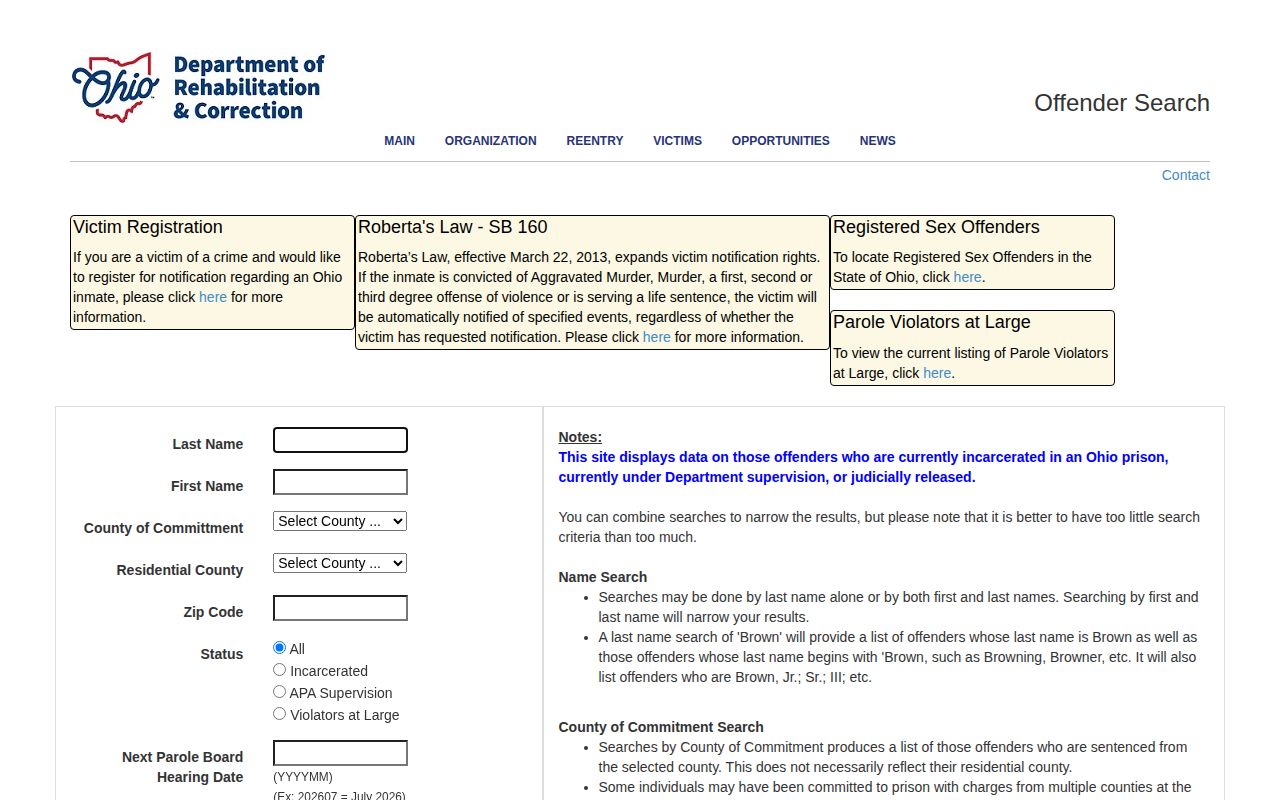
The interface capture supports the search route, but the exact person detail must be opened before naming any projected or actual date.
Use the offender number when possible. Compare date of birth, convictions, commitment county, and sentence detail. ODRC says release or parole detail appears after release or parole and is blank for an incarcerated person. A blank field is not permission to calculate a date from general rules.
ODRC offender numbers follow formats that differ from a SEORJ jail ID, a court case number, a federal register number, or an ICE A-number. Keep each identifier with its source. ODRC generally instructs users to enter six digits without spaces or hyphens, with a leading zero for a five-digit female number. A number that fits the format still needs identity checks against the detail record.
Ohio Credits Affect Morgan Releases
Ohio has no single rule that every prisoner serves a fixed percentage of every sentence. The sentence type, offense, date, mandatory terms, jail credit, and earned-credit eligibility must be identified first. ORC 2967.191 applies qualifying credit for prior confinement. ORC 2967.193 and ORC 2967.194 govern program or activity-based earned credit through frameworks that include exclusions, caps, provisional awards, denial, and withdrawal.
For a non-life felony indefinite sentence, ORC 2967.271 creates a presumption of release at the minimum or qualifying presumptive earned-early-release date. Statutory procedures can maintain incarceration. The imposed minimum and maximum terms are shaped by ORC 2929.14 and ORC 2929.144. Mandatory terms and offense-specific laws can restrict reductions.
Old-law indefinite and life terms raise different Parole Board rules. ORC 2967.13 has sentence and offense-specific eligibility thresholds. A Board projected date remains conditioned on conduct and program compliance and can be rescinded. It does not create an entitlement to leave on that day.
Jail-time credit and earned credit are also distinct. Jail-time credit recognizes qualifying prior confinement. Earned credit depends on the statutory program or activity framework and the person's eligibility and record. Neither should be estimated from a news account or from another person's case. The official calculation and the sentencing entry are needed to explain how a displayed Morgan County date was reached.
Note: Read the sentencing entry before applying any Ohio credit law, because the governing sentence scheme controls which calculation is relevant.
SEORJ Morgan County Release Timing
County-jail calculations must not be borrowed from ODRC. For a pretrial SEORJ detainee, release may turn on bond, recognizance, dismissal, another hold, or a court order. For a locally sentenced person, obtain the commitment or sentencing entry, the credited time, and the jail's release record. The research found no official SEORJ good-time formula, weekend-release rule, or public release-processing schedule. No local formula should be asserted without direct confirmation.
SEORJ's linked roster shows current custody information, including charge-level disposition and total bail, but neither field proves release. A bail amount does not show that payment was accepted or that all holds cleared. The roster also lacks a release date, release type, archive, and projected-date filter. Check its run timestamp before using it even as evidence of current listing.
A court may order release while jail staff still complete identity checks, property processing, or review of other holds. The research did not document how SEORJ handles those steps or how long they take. The court order is legal authority, while the jail discharge entry is proof of the completed custody event. Report both dates when they differ instead of forcing them into one timestamp.
Morgan County Court and Common Pleas records can explain the legal event. Ask SEORJ at 740-753-4060 about custody or the release record. Under ORC 341.02, the jail register includes the date and manner of discharge. That entry confirms what happened after the date was calculated.
Morgan County Release Date Changes
A projected date can move because it is built from facts and legal decisions that may change. The source should be checked again after any new court event, institutional decision, detainer, or calculation correction. One agency's estimate also cannot account for custody that another agency will take next.
| Factor | Possible effect | Record to check |
|---|---|---|
| Credit award or correction | May move the computed date earlier or later | Sentence calculation and ODRC detail |
| Credit denial or withdrawal | May postpone an expected date | Applicable ODRC record and statute |
| Detainer, warrant, or hold | May cause transfer or continued custody elsewhere | Holding agency and court docket |
| New or amended court order | May change the sentence, credit, or release authority | Latest journal entry |
| Parole decision | May grant, continue, deny, condition, or rescind a date | Board minutes and person detail |
| Judicial release | May replace the prison path with court supervision | Common Pleas order |
| Transfer | Changes the custodian without proving community release | Departure and destination records |
A next parole-hearing date is especially easy to misread. ODRC defines a future date as a review expected roughly before the displayed date so the hearing and decision can occur. Being scheduled is not a grant. Open the individual detail and the actual Board minutes or decision before reporting the result.
Confirm Morgan County Actual Release
Record the exact projected label and capture date. Read the sentence entries and any governing statute. Then confirm after the event with the source that controls custody. ODRC Released status and release detail confirm a state-prison departure. APA Supervision means the person is out of prison under continuing state control. SEORJ's jail register confirms a local discharge or transfer and states its manner.
A Morgan County VINE inmate check can add a custody-change alert when the relevant agency participates. It should supplement, not replace, the underlying agency record. For federal cases, use BOP and the federal docket. For ICE, use ODLS for current or recent location and contact the agency for older details.
Never promise a pickup time from an expected date. The research found no official SEORJ release hour or exit practice, and an ODRC date is not a gate appointment. Processing, holds, transportation, or agency handoff can affect when and where the person physically leaves.
Keep a dated copy of each source used in the comparison. A later ODRC detail can replace an estimate with release or supervision information, while a new Morgan court entry can alter the authority that the jail must follow. If two records conflict, ask each custodian what its field means and which event it records. Do not silently combine a court order date, a projected prison date, and a physical jail departure into one claimed release date.
Note: A past projected date should be replaced with an actual release, transfer, or continued-custody record whenever one is available.