
Morgan County Parole and Probation
Parole and probation both allow a person to live outside a jail or prison while following enforceable rules, but they do not arise the same way. In Morgan County, parole is tied to release from an eligible Ohio prison sentence and is administered through the Ohio Department of Rehabilitation and Correction, Adult Parole Authority. Post-release control is another ODRC form of supervision for qualifying newer sentences under Ohio Revised Code 2967.28. Probation, often recorded in Ohio as community control, is imposed by a court instead of prison or after judicial release. The case docket identifies the court and its order.
Physical release only answers where the person is held. It does not show whether legal control remains. An ODRC status of APA Supervision means the person has left prison but remains under departmental control. A Morgan County Court or Common Pleas entry imposing community control points to court supervision instead. Final discharge occurs when the controlling authority ends supervision. That date may be later than the jail or prison release date.
| Supervision type | Who imposes it | Best public check |
|---|---|---|
| Parole | Ohio Parole Board under eligible sentence law | ODRC Offender Search and Board record |
| Post-release control | Ohio sentencing law and ODRC APA | ODRC status, release detail, and sentence entry |
| Probation or community control | Morgan County sentencing court | County Court or Common Pleas docket |
| Judicial release supervision | Sentencing court | Common Pleas judicial-release order |
- Parole
- Conditional release under the Parole Board for a sentence that uses parole eligibility.
- Probation
- Court supervision in the community, commonly called community control in Ohio records.
- Post-release control
- APA supervision that follows qualifying modern prison terms.
- Discharge
- The formal end of the applicable custody or supervision term.
Check Morgan County Release Supervision
Start with the last custodial system. A person released from an ODRC institution may be on parole or post-release control. A person discharged from Southeastern Ohio Regional Jail after a local sentence may instead be on community control through a Morgan court. The ODRC Offender Search has separate status choices for Released, APA Supervision, Violators at Large, and Incarcerated. County of commitment means the sentencing county, not necessarily the county where the person now lives.
- Gather the full name and, when known, date of birth, court case number, or ODRC offender number.
- Search ODRC statewide. Try the offender number first, then a broad name search before narrowing to Morgan as county of commitment.
- Open the matching record. Compare identity, conviction, commitment county, release detail, status, and supervision expiration data.
- If the person was never sent to ODRC, search the Morgan County Court docket for misdemeanor cases and the Common Pleas CourtView for felony cases.
- Read the latest journal entries. Look for community control, judicial release, termination, violation, warrant, or final discharge language.
- Resolve any conflict with the office that owns that record. SEORJ answers custody history, ODRC answers APA status, and the court clerk maintains its docket.
The ODRC definitions page also explains that address data for supervised people can lag. It should not be treated as a verified present location. When a record shows only Released, inspect the release and supervision fields rather than assuming all sentence obligations ended on that day. The full Morgan County release-record path is available from the released-inmate search and records hub.
Morgan County Supervision Record Contacts
ODRC is the correct first contact for public questions about an APA status or offender-search field. The public search contact is statewide, because ODRC may supervise a Morgan-sentenced person outside Morgan County. The search does not publish a verified current address for every supervised person. For local community control, use the court named in the case. Morgan County Court handles relevant misdemeanor matters, while Common Pleas handles felony criminal matters and judicial-release orders.
ODRC Offender Search Contact
P.O. Box 430
Columbus, OH 43216
Phone: 614-752-1161
ODRC search contact page
Morgan County Court is at 37 East Main Street, second floor, McConnelsville, and lists 740-962-4031. The Common Pleas General Division is at 19 East Main Street, second floor, McConnelsville, and lists 740-962-3371. Both publish weekday business hours. Call before an in-person visit, especially on a legal holiday. Ask about the exact case number and record, not for broad claims about a person.
For physical custody or release from SEORJ, contact the regional jail at 740-753-4060. A court order can authorize release, while the jail register records the date and manner of actual discharge. Those sources answer different questions and should be kept separate.
Note: Supervision belongs to the imposing authority, so a Morgan commitment does not always mean the current supervising office is located in Morgan County.
Morgan County Supervision Violations
A violation claim should be checked through the authority responsible for supervision. ODRC maintains a direct Violators at Large list for APA cases. The table includes a photograph indicator, full name, offender number, date of birth, date declared at large, and offenses. A person shown there is wanted by APA for an alleged supervision violation. The listing does not prove a new conviction, show a verified present address, or set a new release date.
The captured ODRC Violators at Large page shows the statewide fields available for an APA supervision check.
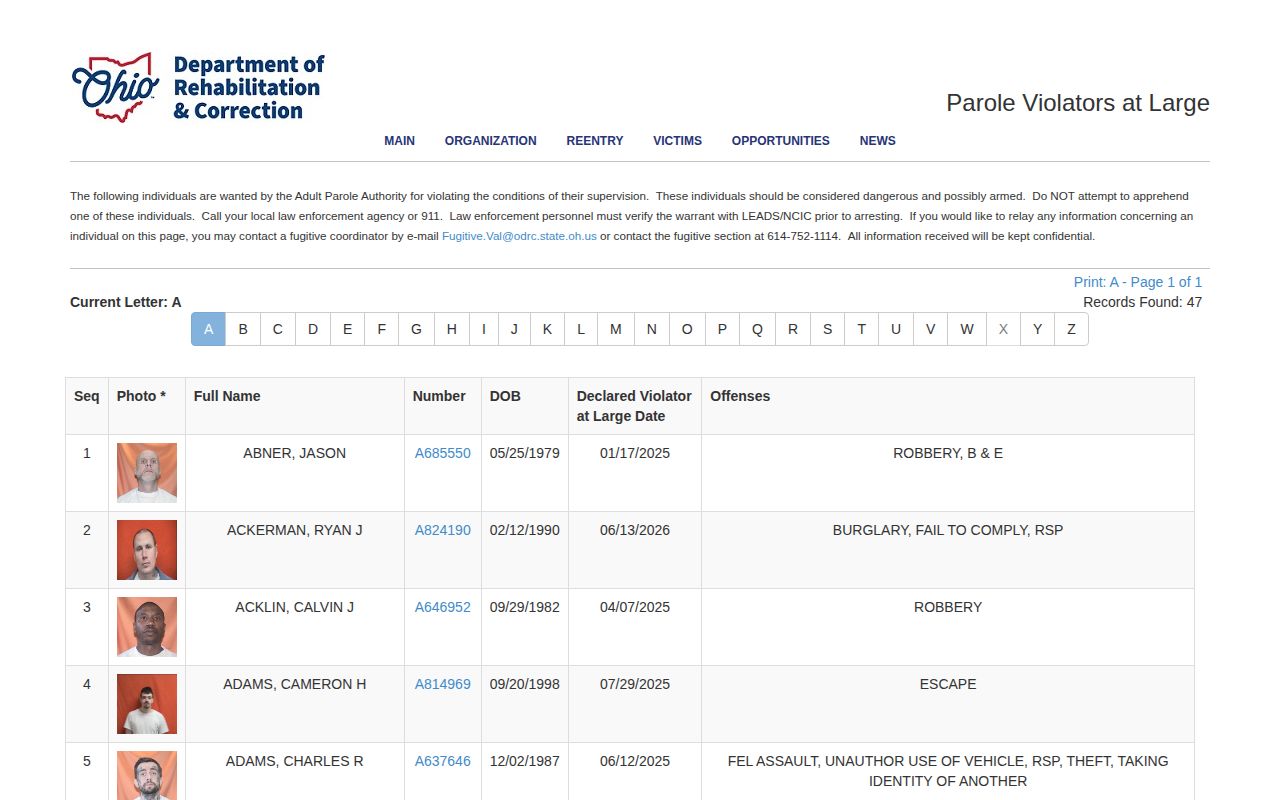
The capture documents the public interface, while the live list and later agency or court record control the current status.
An absconder is a supervised person whom the agency says has stopped reporting or otherwise cannot be located as required. The Morgan County Sheriff navigation reviewed for the research did not publish a county warrant or absconder list. Do not substitute news posts for an official warrant check. For court-supervised probation, inspect the docket for a violation filing, hearing order, capias, warrant, revocation, or termination. Then contact the issuing court or agency for the current record.
VINE can report a custody change when a participating agency supplies data, but it is not a supervision-compliance system. A VINE alert may follow an arrest, release, or transfer without explaining the underlying APA or court action. Confirm the event with the agency named in the notification.
Conditions are set by the governing order and should not be guessed from the status label. They can address reporting, travel, conduct, treatment, or other case-specific duties. A public ODRC or court record may show the existence of supervision without displaying every protected detail. If a violation is alleged, the filing or VAL entry is an allegation within that process. Read the later hearing and disposition before describing the result.
Correct Morgan County Supervision Records
Morgan County has a useful agency-specific correction path. The County Court rules state that records filed after January 1, 2006 are kept electronically as text and images. When a court docket has the wrong entry or image, identify the case and contact the clerk that maintains it. Do not ask SEORJ to change a court docket. In the same way, a court clerk does not control a jail-management field or an ODRC status.
A SEORJ custody or release error should go to the jail custodian. An ODRC release, supervision, or offender-number issue should go through the ODRC public search contact. Supply the exact page, field, person identifier, and date seen. A narrow request makes it easier to locate the source record and avoids mixing people who share a name.
When two systems disagree, preserve both timestamps. A court order states legal authority. A jail register shows physical custody history. ODRC shows state custody and APA status. One office should not be expected to rewrite another office's record.
Ending Morgan County Release Supervision
Supervision ends only through the authority that controls it. ODRC defines expiration of the supervision term as the maximum period of APA control fixed by the court, statute, or Parole Board minutes. Authorized early termination can occur, so the displayed expiration date and an actual discharge action are not always the same event. Review the latest ODRC detail and, for parole matters, the controlling Board material.
For Morgan County probation or community control, look for a court order that terminates supervision or records final discharge. A person can finish physical confinement long before that order. Conversely, a revocation may return the person to custody. A transfer to another authority also changes the search route without ending the underlying case or sentence.
Judicial release also requires careful wording. It is a court-authorized departure from state prison that generally places the person on community control. The Common Pleas order explains the terms and responsible authority. It should not be described as ordinary parole merely because both statuses involve a person living outside prison. The latest docket entry shows whether that court supervision continued, changed, or ended.
Public access has limits. Ohio's Public Records Act includes exceptions for protected information, and ODRC inmate-file access is limited by ORC 5120.21. Use the public offender search and court docket first. Ask the record owner for the legal basis when part of a responsive record is withheld.
Note: Final discharge is a legal status in its own right and should not be inferred from silence, a missing name, or an old projected date.